Why you shouldn't peek early — and what to do instead while your experiment is live
Last updated: September 17, 2026
Customers often come to us wanting an early read once an experiment has launched — especially when a channel looks inefficient in an MMM, or when a holdout is meant to validate whether a channel is truly incremental. The instinct is understandable, but acting on it works against the thing the experiment is meant to give you: a trustworthy answer. Here's how we think about it.
1. Peeking early is genuinely risky, not just premature
Every experiment is sized around a target effect and a planned duration, calculated from your business's target-metric volume. That sizing is what gives the eventual result its statistical power. Looking before the design is complete undermines that in a few specific ways:
The result is probably just noise. Early data hasn't had enough volume to smooth out normal variation, so an early peek is more likely to be inconclusive — or to show a "signal" that isn't real.
Peeking repeatedly inflates false positives. Every additional look at the data before it's ready raises the odds of concluding there's a lift when there isn't one.
Delayed-response channels distort even more. Channels like CTV, YouTube, or radio influence conversions over days or weeks (lag/adstock effects). A mid-test snapshot systematically understates or misrepresents the real effect for these channels, because the tail of the response hasn't happened yet.
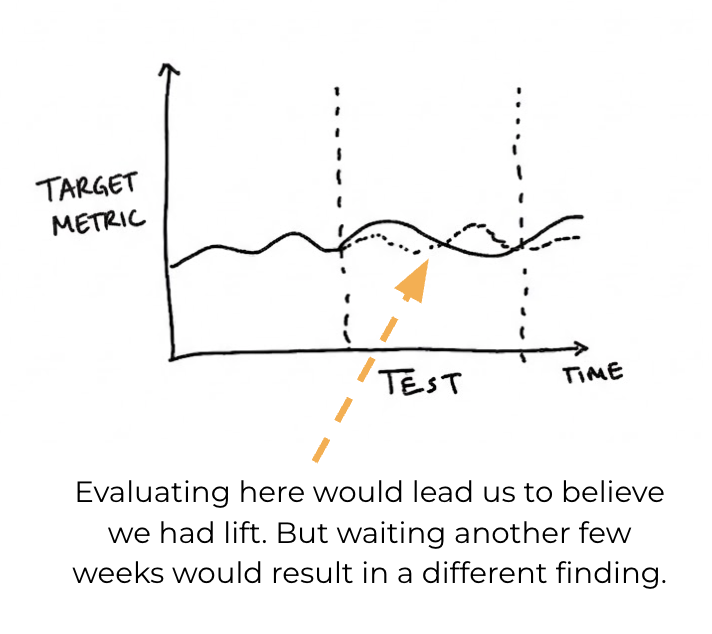
The statistical version, for those who want it: Every experiment is powered against a Minimum Detectable Effect (MDE) or the smallest lift the design can reliably distinguish from noise, given the expected sample size and target-metric volume over the planned duration. That power calculation assumes a single look at the end of the test. Checking repeatedly before then is a multiple-comparisons problem: each additional look raises the real false-positive rate above the nominal significance threshold the test was designed around (the well-known "peeking problem" in sequential testing). Practically, that means an early observed lift or p-value isn't comparable to the one the experiment was built to produce because the confidence interval hasn't converged, and for lagged-response channels the true effect hasn't fully materialized in the data yet either.
None of this is a knock on your instinct to look; it's just what happens statistically when a test is read before it's finished.
2. We don't recommend it, and we generally won't issue an early read ourselves
Because of the above, Paramark doesn't provide an official performance conclusion, lift estimate, or budget recommendation before an experiment reaches its planned duration and volume. This holds even when a channel has been flagged by an MMM refresh as a possible concern. I's a good reason to run the experiment, not a reason to shortcut its timeline. A new test still needs to finish before it can override or validate what the model is telling you.
It also means we're not spending Growth Advisory or engineering time re-analyzing a live test mid-flight. That time is better spent making sure your final readout — and your other deliverables, like MMM refreshes — land on time and hold up.
3. Even if you look anyway, don't decide anything from it
If you (or we) do glance at in-flight numbers, the right response is almost always to keep running the test, not to act on what you saw:
An early look doesn't have the confidence intervals needed to support a pivot. In nearly every case, "keep running it for the full duration" is the only defensible conclusion you can draw from a partial read.
In-platform metrics don't fill this gap either. They can be directionally interesting for day-to-day campaign management, but they aren't a statistically valid substitute for an incrementality readout — they don't answer the counterfactual question the experiment was built to answer (what would have happened without the spend?).
The one exception is a genuine business emergency: if you see a catastrophic shift in baseline volume that suggests a real threat to the business, that's worth flagging immediately so we can jointly revisit whether the test needs to be paused or revised. That's a business-continuity call, not a performance conclusion.
Why an early "significant" result still isn't actionable: because the test hasn't reached its planned volume, any confidence interval you'd compute mid-test is wider than the one the design targets — and if you've looked more than once, the interval you'd naively compute understates the true uncertainty (that's the multiple-comparisons effect from section 1 again). A result that clears a significance threshold early is more likely to be a false positive than the same result would be at the test's planned endpoint.
4. What you can take away from an early peek
Even though we won't turn early data into a performance conclusion, a mid-test look still has real value — just a different kind:
Execution health — confirming geo targeting, holdouts, exclusions, blackout states, and budget settings are working as designed.
Design integrity — checking that no operational change has contaminated the test or created overlap that would compromise the final result.
Business risk monitoring — watching for the kind of extreme anomaly described above.
Pacing and timing confirmation — whether the test is on track, whether execution still matches the design, and when the next formal readout is expected.
If you want interim visibility during the live period, this is the shape it should take: a directional status update, not an early result. It confirms the test is healthy and on schedule — it should never claim a channel is working or not working before enough post-treatment data has accumulated.
When should you expect a real answer?
A credible read is available once three things are true:
The planned treatment window is complete.
Any required post-treatment or cooldown period has passed (this varies by channel — a slower, lag-heavy channel needs more of it).
Paramark has completed the formal analysis against the control markets.
As a rough guide, a newly launched CTV incrementality test typically needs about 4 weeks of live runtime before it's ready for a read, plus whatever cooldown the design calls for. Slower, top-of-funnel channels like radio or audio often need longer — for those, we can confirm the launch happened as planned and share the expected analysis window, but we still won't convert the first few weeks of in-flight data into an official lift read.
Bottom line
If your experiment is still live, expect us to help you confirm it's running correctly — and to hold off on a verdict until the full design window is complete. That patience is what makes the eventual answer one you can actually use to make a budget decision.
Want to learn more about experimentation? Check out other Paramark experimentation articles here.